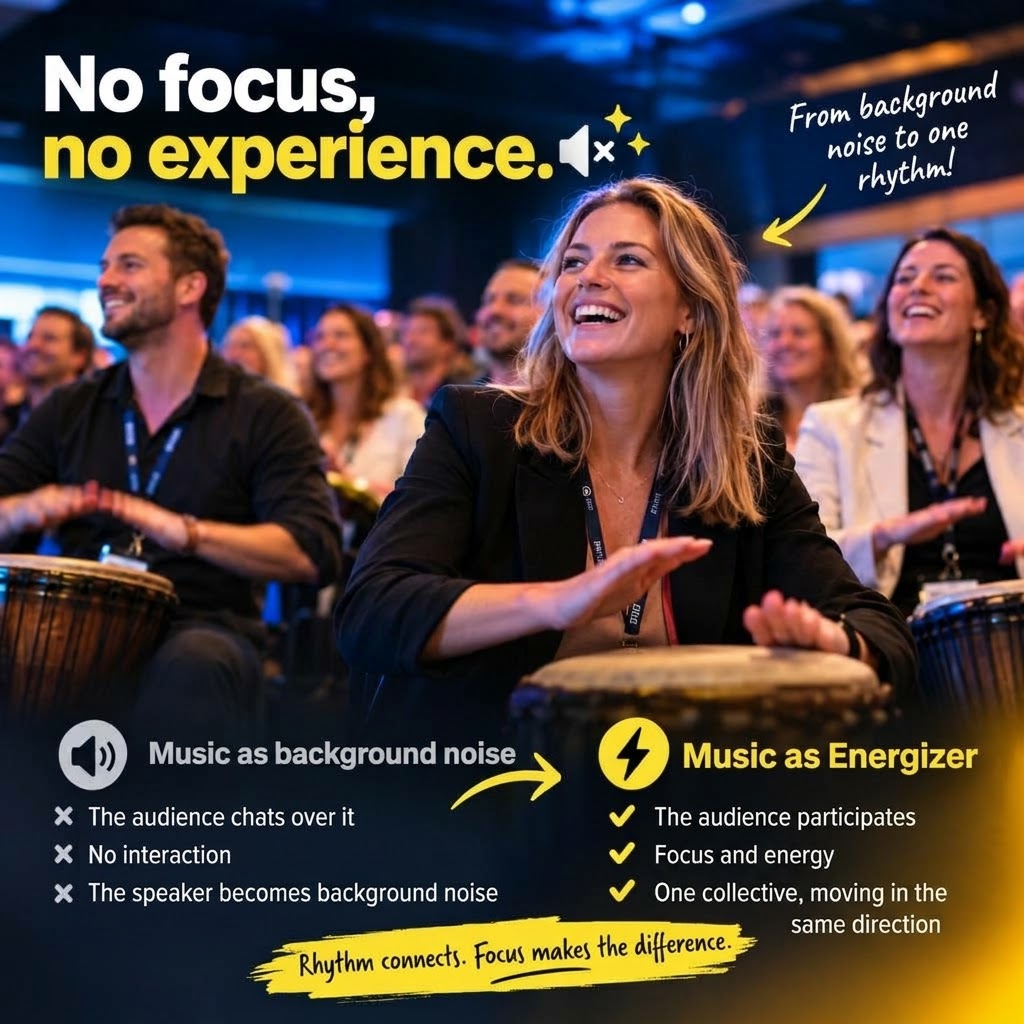
No genuine interaction is possible without focus.
Would you talk while a comedian is delivering their punchlines?
Or hold a phone conversation during a theatrical performance?
Almost certainly not. You intuitively understand that a lack of focus robs you of a significant portion of the experience and the depth of what is unfolding in that moment.
Yet, I still see this phenomenon occur alarmingly often during business conferences and interactive workshops: participants mindlessly scanning their phones, answering emails, or engaging in hushed conversations.
The speaker standing before them—doing their absolute best—slowly but surely fades into nothing more than background noise.
The message is completely lost.
Fundamentally, there are two distinct ways in which entertainment or a presentation can play out within a gathering:
- Music as background noise (The “wallpaper” effect)
Imagine a talented live band playing in a crowded, noisy tavern.
The guests keep talking right over the music; there is no conscious engagement whatsoever, the connection is entirely absent, and the performers are effectively reduced to musical wallpaper.
This is precisely what happens when a speaker fails to capture the room. - Music as a driving force (The catalyst)
This is where a genuine, meaningful transformation takes place.
Here, the dynamic serves not as mere filler, but as the engine of the space. When a room is filled with uninspired or weary people, what helps to instantly restore their focus and sharpness?
Exactly this: compelling them to undergo a transformation—from passive listeners into actively engaged participants. By assigning an active role, you engage the brain and restore the connection to the content.